
 en-US
en-US 

 Telegram
 WeChat


The strengthening of the gold price is a precursor to a sharp decline.
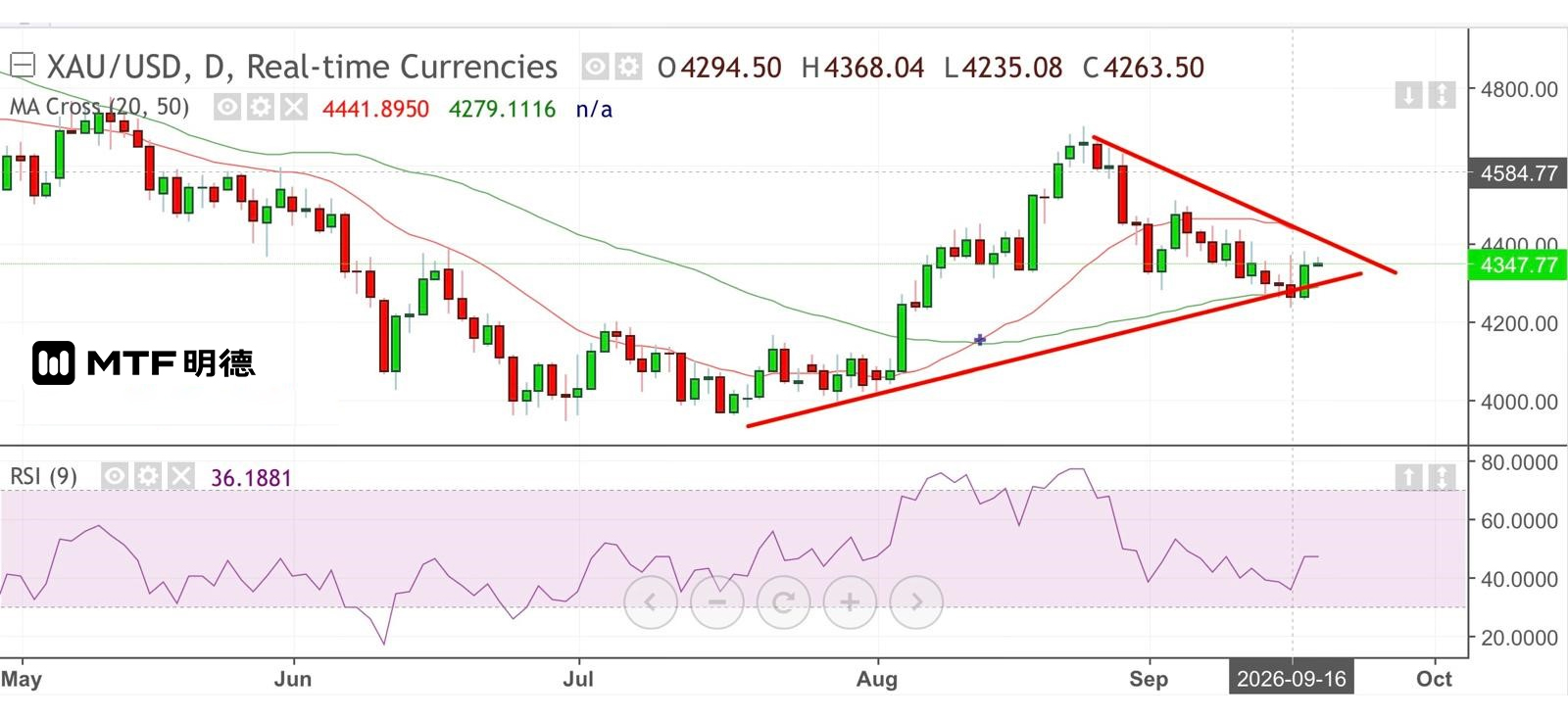
"Strong Gold Prices Signal an Upcoming Sharp Drop" – Completed on 18/09/2026 at 10:07
Following the Federal Reserve's unanimous decision to raise interest rates by 0.25%, gold prices initially plunged sharply but then rebounded steadily, gaining over $100 yesterday—significantly outperforming other major non-U.S. currencies. While higher U.S. interest rates are theoretically extremely negative for gold, why has this time been so unusual? Why hasn't gold fallen with the rate hike, instead recovering strongly after a sharp drop?
I believe this is a precursor to a significant decline in gold prices. First, the Fed’s announcement of a rate hike—and its indication that another 0.25% increase may occur later this year—likely attracted increased selling pressure on gold. However, gold had already broken below the 50-period simple moving average (SMA) on the daily chart (currently around $4,288). Moreover, since the expected next hike is scheduled for December, this timing actually creates a potential catalyst for a rebound. Therefore, I have long anticipated that gold would remain volatile around the 50-SMA and 20-SMA levels in the short term.
On the other hand, the Fed’s shift toward tightening has led to rising real interest rates. Statistics show that when the 10-year real interest rate exceeds 1.5%, or even remains above 2%, gold prices tend to face clear downward pressure. Currently, the U.S. 10-year TIPS yield has surpassed 2.6%, suggesting that a new wave of decline in gold prices is likely imminent.
Investors should watch closely: if gold forms a consolidation zone between the 50-SMA and 20-SMA on the daily chart during the fourth quarter, there will be a high probability of a breakdown into 2027—or even after the U.S. midterm elections. A fall below $4,210 would not only breach the neckline of a head-and-shoulders pattern on the hourly chart but also signal a test of the $3,900 level.
In the short term, gold is expected to remain above $4,310, but the resistance zone between $4,360 and $4,380 is critical. Even if this range is breached, further upside will likely be capped at $4,410. Overall, I anticipate greater volatility and sideways movement in the near term.
The above information is for reference only and does not constitute investment advice.


