
 en-US
en-US 

 Telegram
 WeChat


Gold price likely to fall below 4,100
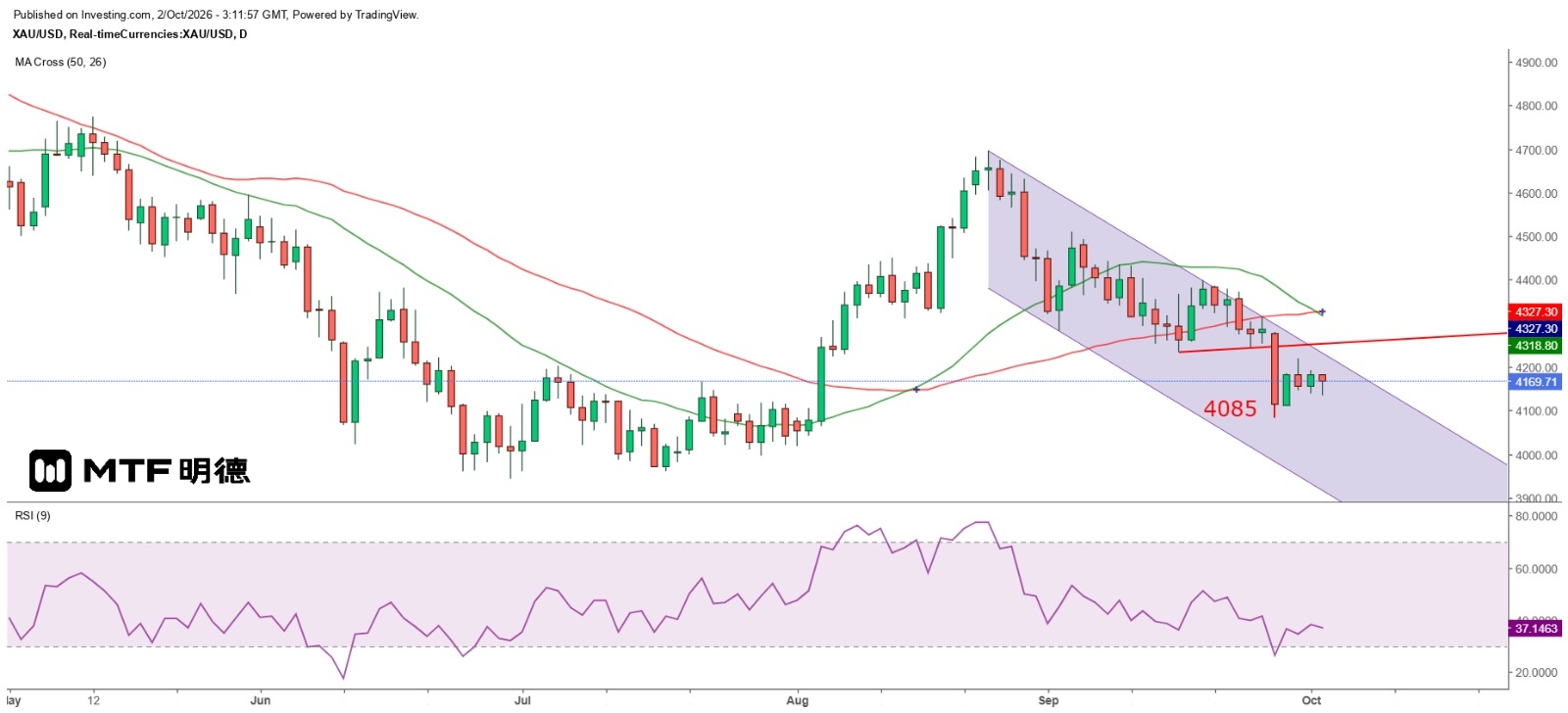
Gold Market Analysis: High Chance of Gold Price Breaking Below 4,100
October 2, 2026, 11:06 AM (Completed)
Yesterday, gold prices traded sideways after rising from $4,139 to $4,193 in the Tokyo morning session, fluctuating mainly between $4,150 and $4,188—representing a rare low-risk range-bound trading environment. The price volatility clearly indicates that gold remains within a weak support zone at $4,110 and a strong resistance level at $4,210. This morning, gold sharply dropped to $4,134 before recovering quickly, yet has not managed to return to $4,160—the midpoint of the aforementioned range—and briefly tested below yesterday’s sideways trading floor, signaling continued weakness in the price trend.
Tonight, the U.S. Department of Labor will release the September non-farm payroll report. As long as job changes are not extremely negative—such as a drop of 100,000 or more—gold is unlikely to reverse its downward bias. In fact, if the data disappoints expectations and triggers a sharp rebound, it would present an ideal opportunity for selling at higher levels. One reason is that the Federal Reserve stated in its September policy statement that the U.S. economy is expanding steadily, domestic consumption remains resilient, productivity growth is robust, capital spending is solid, job growth aligns with labor force expansion, and the unemployment rate has remained nearly unchanged.
Moreover, the second-quarter GDP annualized quarterly figure was significantly revised upward to 2.1%, while the Chicago Purchasing Managers Index surged to 58.8 in September—returning to expansion territory and far exceeding the expected 51.2. Additionally, core PCE inflation rose 3% year-on-year for the third consecutive month. Under these economic conditions, the Fed is highly unlikely to cut interest rates; instead, it is only considering timing for further hikes. With interest rates remaining stable and trending upward, the cost of holding gold continues to rise rather than fall. Therefore, tonight's non-farm report is almost certain not to strengthen gold prices.
Thus, the strategy should remain focused on selling gold on rallies. If the non-farm data turns slightly weaker and gold surges, short positions could be established between $4,180 and $4,210, with stop-loss placed above $4,210. Conversely, if the data proves strong, gold is likely to break below $4,100. Prior to the data release, gold is expected to continue volatile intraday movements. Investors may still consider selling above $4,180, with $4,150 serving as a key short-term technical support level. Once gold confirms a break below $4,110, the next target will be the psychological threshold of $4,000.
The above information is for reference only and does not constitute investment advice.


